

A National Plan for the Chemical Industry in Israel
The National Plan for the Chemical Industry in Israel is a large project that the Samuel Neaman Institute has been leading since 2004. The project analyzes past and present chemistry and pharmaceutical branches produced in Israel, present alternatives and demonstrates new industry branches in this field. This project compares this industry with other global markets […]
The quality of Israeli academic institutions: what the wages of graduates tell about it?
Higher education in Israel expanded rapidly in the last ten years with the opening of academic colleges. This study examines the return on education, in terms of salaries, of first degree graduates from colleges compared with that of university graduates, controlling for cognitive abilities and socioeconomic characteristics. The use of Propensity Score Matching shows that […]
Equity and Efficiency Effects of Different Funding Arrangements for Higher Education: A Calibrated Analysis Applied to Israel
We construct a macro-model of an economy with skilled and unskilled labor, and a centralized system of higher education, calibrate it to the parameters of Israel’s economy and university system, and then use it to simulate different modes of financing higher education so as to gauge their effect on output, distribution and mobility. We find […]
The Possible Role Of Israeli Solar Technologies In The Meadowlands’ Renewable Energy Efforts
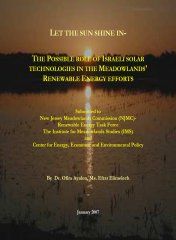
The SNI was asked by the NJ Meadowlands Commission (NJMC)- renewable energy task force, the Institute for Meadowlands Studies (IMS) and the Center for Energy, Economic and Environmental Policy to pinpoint Israeli companies, which are capable of participating in solar energy tenders at NJ, Meadowlands. The current report examines Israeli companies in the […]
Reclaiming the Dead Sea, Alternatives for Action
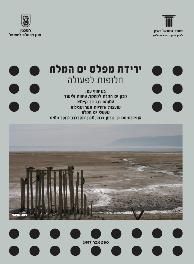
The Dead Sea, the lowest and saltiest sea in the world, is currently in a state of severe environmental degradation. Water extraction from the Jordan River, the Sea of Galilee, and the Yarmouk River for Israel, Jordan, and Syria, as well as the extraction of Dead Sea water for industrial plants in Israel and Jordan, […]
Two Seas Canal – Is it a real aim or some kind of a preconceived solution to an unspecified target?
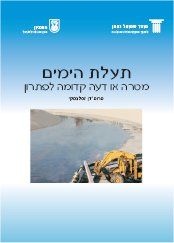
This paper deals with the necessity of finding alternative water resources to Israel’s emptying water reservoir. The author, Prof. Dan Zaslavsky, is rejecting in this paper the idea of The “Two Seas Canal” (an idea that was rejected formerly five times for economic inefficiency and for other various reasons) and is suggesting two different alternatives. […]
A Strategy for Developing Employment Opportunities for the Arabs in Israel: The Vision for Expanding the Arab Middle Class
This study analyzes the problems that face the Arab community in Israel in the field of work and employment. It presents a strategy for developing employment opportunities for the Arab minority in Israel. Moreover, the study suggests a new vision for expanding the Arab middle class in Israel by developing equal employment opportunities.
Energy efficiency in Ein Harod Ihud
The work was prepared as part of the Ein Harod Echud project – Kibbutz Yerok. The purpose of the work was to examine ways to save/reduce energy costs in the group and to propose cost-saving measures that include the use of alternative energies, while meeting the criteria of economic viability. The initial report focused on […]
Proceedings of the International Conference:
This volume contains the papers presented at an international colloquium entitled “Transition to Mass Higher Education – International Comparisons & Perspectives” which took place at the Samuel Neaman Institute at the Technion, in Haifa, Israel on December 5-6, 2004. In addition to the full papers, the volume also contains the questions and answers following each paper, […]
The Cycle of Violence? An Empirical Analysis of Fatalities in the Palestinian-Israeli Conflict
This paper studies the dynamics of violence in the Palestinian-Israeli conflict since the outbreak of the Second (or “Al-Aqsa”) Intifada in September 2000, during which more than 3,800 Palestinians and more than 1,000 Israelis have been killed. The conflict has followed an uneven pattern, with periods of high levels of realized violence and periods of […]