

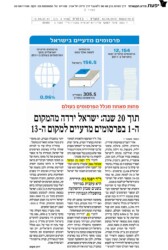
Israel producing fewer scientific studies per capita
Yair Even-Zohar, Ella Barzani, Daphne Getz, Noa Lavid
The study by the Samuel Neaman Institute for National Policy Research and the Science and Technology Ministry’s National Council for Research and Development also shows Slight decline in the quality of research published. From 2007 to 2011, the latest year for which figures are available, Israel was ranked 15th in the quality of its research, while from 2001 to 2005 it was ranked 12th.
High- Tech Companies Gain from Israeli R&D
Daphne Getz, Amir Hefetz, Eran Leck
A new study by the Samuel Neaman Institute and the National Council for Research and Development, part of the Israeli Science and Technology Ministry, reveals that there is a significant rise in the absolute number of distinct inventions filed by foreign R&D centers and in their respective share out of total Israeli inventive activity. The research identified increasing trend of obtaining Israeli IP by means of acquisition of Israeli firms and start-ups. Acquired patents are becoming a substantial share out of the total patent portfolio of foreign R&D centers in Israel.
Foreign R & D centers are not the problem – but a part of the solution
Recently, the findings of a study done by the Samuel Neaman Institute and the National Council for Research and Development have been published. The research divided Israel patent records by attributing them to the patent source. The study showed that 27% of patents registered in the name of foreign R&D centers in Israel.

Prof. Oz Almog and the WhatsApp of Salma from Isifya
“My lovely friend, Salma, is a 23 years old young lady from the Isifya village that doesn’t let go of her smartphone. “Can I have a glimpse at your WhatsApp list?” I said hesitantly. “Certainly, why not?” she replied, with typical generosity.
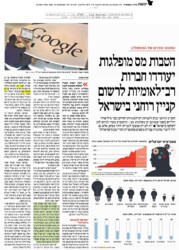
Excessive tax benefits will encourage national companies to register intellectual property in Israel
“There is no doubt that there are positive aspects in the wish of multi-national high-tech companies to operate in Israel, but there are also elements that may harm us, and we should see the overall picture,” says Daphne Getz, who conducted a research on R&D output in Israel at the Samuel Neaman Institute at the Technion.
Who’s at the forefront of Israeli innovation?
Daphne Getz, Amir Hefetz, Eran Leck
Foreign firms, not local startups, are the biggest source of Israeli patents, a study by the Samuel Neaman Institute has found.
Dr. Daphne Getz, who authored the study together with Dr. Eran Leck and Amir Hefetz, explains that because they are small, startups were hard hit by the global economic crisis, and have also been hurt by decline in venture capital funding.

Israel is ranked sixth among OECD countries in PCT patent application submissions of inventors in relation to population size
Research of the Samuel Neaman Institute at the Technion and the National Council for R & D at the Ministry of Science, Technology and Space on the characteristics of the activity in the field of inventions in Israel, found that in 2010 Israel ranked sixth among OECD countries in submitting patent applications in the PCT route of inventors in relation to population.
The defiance virus
Reuven Gal, Ilia Zatcovetsky
Two documents authored by the research-planning project “Integration of the Ultra-Orthodox into Israel’s Economy”, led by Dr. Reuven Gal at the Samuel Neaman Institute at the Technion, shed light on the facts. Researcher Ilia Zatcovetsky found that the Haredi student population in Israel has grown in six years by more than a double – from 3,000 in 2006 to 7,350 in 2012 – and concluded that in the upcoming academic year it will reach 10,000.
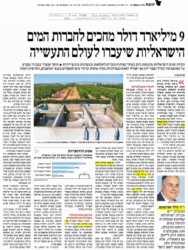
Israel’s water expertise – an industrial moneymaker?
Gilead Fortuna, Shiri Freund-Koren
Billions to be made by helping companies meet green regulations.

Haifa vs Ashdod / / Netanyahu’s moment of truth: How many new ports Israel needs – and where
In the next few days, the Prime Minister will determine whether to establish two private ports, as required by the Ministry of Transport, or settle for one, at the request of the Finance Ministry – and decide where the first port will be established ■ The difficult dilemma shows that the decision does not lean on professional considerations only since it will carry national and strategic implications