


Evolutionary Innovation and High Tech Policy: What can we Learn from Israel’s Targeting of Venture Capital STE-WP-25
The paper analyzes Israel’s Innovation and High Tech Policy from a Systems-Evolutionary (S/E) and Life Cycle Perspectives with a focusing on the targeting of the Venture Capital Industry during the 1990s. Other related research strongly suggested that the emergence of Venture Capital (VC) during that decade was a central vector in the re-configuration of Israel’s […]
Public vs. Private Technological Incubator Programs: Privatizing the Technological Incubators in Israel STE-WP-26
The Public Technological Incubator Program (PTIP) was initiated in the early nineties by the Office of the Chief Scientist (OCS) in the Ministry of Industry and Trade in Israel in the wake of a large influx of immigrants from the former USSR, many of whom were scientists and engineers. Since the year 2000, private technological […]
Monopolies in Competition:The Balance between Innovativeness and Competition in the Israeli Competition Law STE-WP-27
Law plays an important role in the formation of incentives for the creation as well as the diffusion of intellectual property. Intellectual property laws and competition law are of special importance. Intellectual property laws determine when an inventor is entitled to receive an exclusive right to use his invention. The grant of such a right […]
The Technological Incubators in Israel: Technological Policy in an Era of Privatization
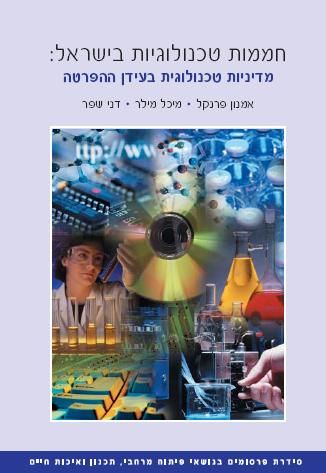
During the last twenty years there has been a concentrated efforts made by the Israeli government to support and develop the high-tech industry. Among other means, a prominent place is kept for the Technological Incubator Program, which was established in 1991. The technological incubators are supportive frameworks, which help initiators in their first steps to […]
A sustainable vision versus a sprawling reality? The Urban sprawl Pattern in Israel

Urban sprawl is a form of spatial development, characterized by low densities, scattered and discontinuous “leapfrog” expansion, and segregation of land uses, that is mainly found in open and rural lands on the edge of metropolitan areas. The early stage of urban sprawl, often referred as suburbanization, started at the end of the industrial era […]
Firm Growth Profiles (FGPs): Towards an Action-Based View of Firm Development STE-WP-24
The paper presents the concept of the Firm Growth Profile (FGP) which contributes to the creation of a dynamic Resource-Based View theory by explaining how capabilities are developed in path-dependent processes. An FGP represents the pattern of critical actions taken by a firm in different value activities (e.g. R&D, marketing, production and finance) during subsequent […]
Conservation of the rural landscape: Implementation model of sustainable agriculture in selected agricultural areas in Israel
Agriculture produces rural landscape, environmental services, cultural and social values in addition to the marketable food and fiber products. The aim of this research is to suggest policy mechanisms to advance the sustainability of agriculture in Israel. This stage of the research focused on the implementation of such mechanisms in specific regions, following a more […]
Policy Towards Reducing Transportation-Related Air-Pollution in Dan Region
This report summarizes activities carried out today in the municipal and governmental systems all over the world, that have an effect on transportation and air quality related . This literature review identifies technological developments and other transportation concepts and policy measures that are ready for use and could be integrated and affect air quality in […]
Economic assessment of current deposit law and suggested packaging law in Israel
This joint research project, carried out by the Samuel Neaman Institute and ELA- the recycling cooperative, examined the following parameters: Economic costs of the Packaging Law in Israel Implications of expanding the Deposit Law to 1.5 liter bottles Results of the studies indicate that the bottle deposit law in its present form, taking into account […]
Implications of expanding the Deposit Law to 1.5 liter bottles
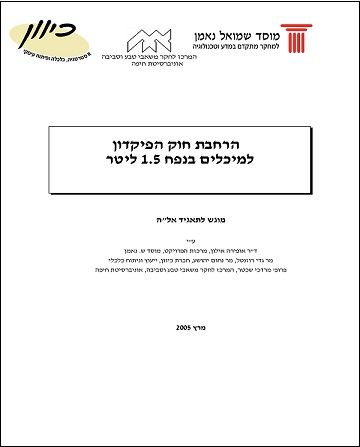
This joint research project, carried out by the Samuel Neaman Institute and ELA- the recycling cooperative, examined the following parameters: Economic costs of the Packaging Law in Israel Implications of expanding the Deposit Law to 1.5 liter bottles Results of the studies indicate that the bottle deposit law in its present form, taking into account […]