
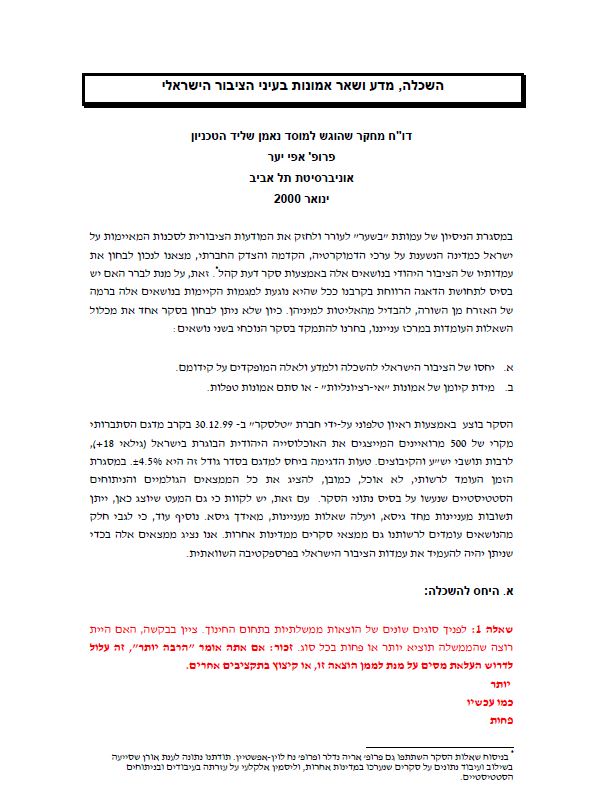
Education, Science and Beliefs in the Eyes of the Israeli Public
Law enforcement in the 21st century :Law, Government&Politics, Science&Technology
This two volume publication contains the research reports and summaries of seminars held in the framework of the perennial project of predicting the state of law enforcement system in the 21st century and to prepare for it. The project was initiated by the Office of the Chief Scientist in the Ministry of Public Security (former […]
Law enforcement in the 21st century: Society, Economy, Minorities, Internal Security

This two volume publication contains the research reports and summaries of seminars held in the framework of the perennial project of predicting the state of law enforcement system in the 21st century and to prepare for it. The project was initiated by the Office of the Chief Scientist in the Ministry of Public Security (former […]
Internet for the Senior Population

The population of the developed countries that is over 65 is growing rapidly, and continues to expand as a result of an increase in life expectancy and decrease in birth rate. It is the challenge of the new century how families, businesses and governments will respond to the needs, preferences and lifestyle of the growing […]
Entrepreneurial Theory and Practice: Immigrant Opportunities
All over the world, many immigrants and their children have turned to small business when faced by the limited opportunities open to them in the labor market. For Israel, essentially a country of immigrants, worldwide experience in this area is of great significance. The recent wave of immigration from the former Soviet Union has greatly […]
Migration To and From Development Towns in Israel

The purpose of this study is to evaluate, on a micro level, the reasons that cause the upper socio-economic class of the population to emigrate from or immigrate to a development town. Such an evaluation may help create a spatial policy that will facilitate the absorption of high-level socio-economic groups of the population into development […]
Technology and Ethics, Proceedings of the Whizin International Symposium, Haifa
This publication summarizes the Proceedings of the first International Symposium on Ethics and Technology, held at the Technion on July 18-19, 1992 as a cooperative venture of the Technion and the University of Judaism in Los Angeles. The interface between science and technology on the one hand and ethics – in particular from a Jewish […]
Absorption of Soviet Immigrants at the Technion
This report describes the Technion’s activities in absorbing immigrant students, scientists, research engineers, the Centre for Pre-University Studies, special courses carried out by the Samuel Neaman Institute, the Division of Continuing Education and External Studies and the entrepreneurial projects already in progress. The report was prepared by the Samuel Neaman Institute, following its pioneering effort […]
Principles and Systems for Planning of Human Resources in Research and Technology in the OECD Countries, and Lessons for Israel
The aim of manpower planning is to ensure efficient use of human resources in a certain country or economic branch, or in a certain company from the point of view of both economic and social development. Opinions differ as to the need for manpower planning and even among those who believe that manpower planning is […]
Development of Higher Education Systems in the Arab Countries – 1965-1988, the Quantitative Dimension. Report No. 7 (for internal use) Project No. 161
During the 1970’s and the second half of the 1980’s the systems of higher education in the Arab countries underwent several transformations which fundamentally changed it. These transformations are divided into three main categories: (1) quantitative changes; (2) quantitative changes that, in themselves, have qualitative implications; and (3) clear qualitative transformation (a-priori). In this brochure […]