
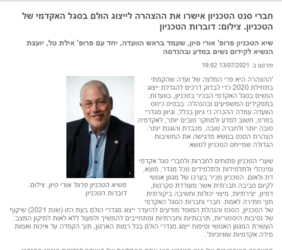
The members of Technion’s Senate approved the statement on fair representation in the Technion’s academic faculty.
The statement follows the recommendation given by a committee established by Technion’s president Prof. Uri Sivan early in 2020, to examine ways to increase women representation in the Technion’s Academic faculty, committees, decision making and management.
Prof. Irad Yavneh Director of Samuel Neaman Institute and Prof. Orit Hazzan, senior researcher in Samuel Neaman Institute were part of this initiative as committee members.
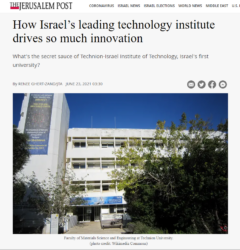
This is the secret to how Israel’s leading technology institute manages to drive so much innovation.
This article presents the new book written by Prof. Shlomo Maital and Rafi Nave: “Aspiration, Inspiration, Perspiration: How Technion Faculty and Graduates Fuse Creativity and Technology to Change the World.”
Together they spent much of the COVID year conducting interviews via Zoom with more than 100 notable Technion graduates asking them about their life journeys, innovations and how it all came about.
Brazil Ranks No. 1 for ‘Aliyah Potential’
Daphne Getz, Ilia Zatcovetsky, Ayelet Raveh
From an article based on research from Ilia Zatcovetsky, Ayelet Raveh and Dr. Daphne Getz:
Brazilian Jews have more reason than ever to leave their country and possess skills very much needed in Israel.
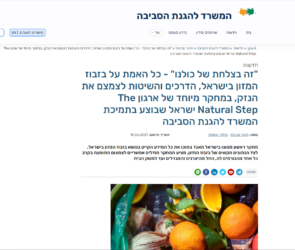
“It’s in our plate” – the whole truth about food waste in Israel, the ways, and methods to reduce the damage
A study, first of its kind in Israel, in collaboration with Prof. Ofira Ayalon, combines all the available information on food waste in Israel.
Along with the data on food waste, the study offers possible models for reducing it, from growers and manufacturers to the household.
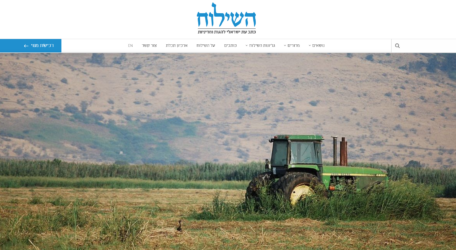
Good will come from the north
Tamar Dayan, Avigdor Zonnenshain, Gilead Fortuna
An article that gives an overview on the northern region of Israel, with reference to one of the most important and thorough documents written in recent years on the issue of economic development in the Galilee: “Upgrading the Economic System of the North of the State” written as initiative of the Ministry of Economy and the Samuel Neaman Institute at the Technion.
Israel is years behind the world in producing energy from clean hydrogen
Gershon Grossman, Naama Shapira
Israel is 7 to 10 years behind the world in the field of energy production from clean hydrogen, according to a new report from Samuel Neaman Institute at the Technion.
The report researchers Gershon Grossman, head of Energy Forum in SNI and Naama Shapira say that the use of hydrogen can help address critical energy challenges, but some significant steps are needed to promote the issue in Israel.
Public involvement and political support are essential to the success of any country in the war against climate change.
What are the guiding principles for climate legislation in Israel?
What are the key components of effective legislation?
What can be learned from countries that have already completed climate legislation?
A discussion of these issues took place as part of an international expert workshop.
As part of a joint venture between the Samuel Neaman Institute and the Ministry of Environmental Protection, which examines the issues, important principles were presented at the workshop, such as the appointment of an advisory committee, transparency, and accountability in the emerging law, along with the need to set clear and measurable goals.
The race to the top: upper-income towers enclave in Tel Aviv
This video story was aired at prime time on Israel’s leading national news program, featuring Neaman Senior Researcher Professor Rachelle Alterman.
While ostensibly focusing on one upper-income towers enclave in Tel Aviv, the story is in effect offers scathing criticism of Israeli urban policies.
These promote construction of towers in most cities and for most socio-economic groups. The justification offered – that towers are mandatory to due to Israel’s small size and population growth – is countered by Alterman, who unveils several undesirable aspects of tower construction and living which will lead to negative impacts.
Paste the Waste: will the plastic bags become glue?
A new development makes it possible to turn plastic bags from polluting waste into glue – is this idea will help to reduce the ongoing environmental damage of disposable plastic?
Prof. Ofira Ayalon explains whether this idea is promising as we would like to believe.
The electric revolution has arrived. So why does it seem like that the exhaust fumes are here to stay for at least another decade?
Idan Liebes
One might think that in a country addicted to cars like Israel, electric cars would be a hit. But as things currently stands, it heads towards a glorious miss.
Idan Liebes, an energy and smart mobility policy researcher at the Samuel Neaman Institute, explains that it’ll be an uphill battle as long as the country will remain addicted to taxes from vehicles that run on fuel, which amounts to roughly one-tenth of its tax revenues.