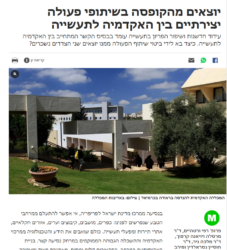
Unconventional collaborations between academia and industry for enhanced creativity
The partnership between academia and industry is essential for promoting innovation and increasing productivity. How can this cooperation be mutually beneficial?
As reported by the Samuel Neaman Institute for National Policy Research in October 2016, the Northern District has a population of approximately 1.47 million citizens, representing 16% of Israel’s total population. In this region, 17% of the population is employed in the manufacturing, mining and quarrying industries, 13% in education, 11% in wholesale and retail trade, and 11% in health, welfare and social services.
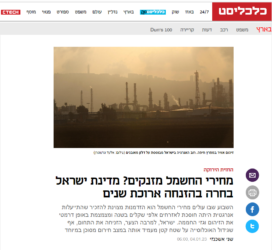
Are electricity prices skyrocketing? The state of Israel has chosen to neglect this for a long time
Energy efficiency would save citizens thousands of shekels a year and dramatically reduce pollution and greenhouse gas emissions.
Israel has been neglecting this field for years, even though the population growth on a small area puts it in a particularly dangerous emergency situation.
Prof. Ofira Ayalon points to the example of the program for energy efficiency at the Technion that managed to save more than 10 times the amount invested in it.
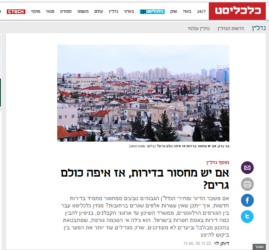
If there is a shortage of housing, then where does everyone live?
Prof. Rachelle Alterman on the data of the housing shortage.
A new study checks: How much is the forest worth to you?
Ofira Ayalon, Tzipi Eshet, Keren Kaplan-Mintz
A new study has revealed what we, Israelis, think about the local forests, and how we usually spend time in them: it turns out that many of us are willing to pay for their existence, that few visit them alone, and that children influence the degree of enjoyment of them (and not for the better).
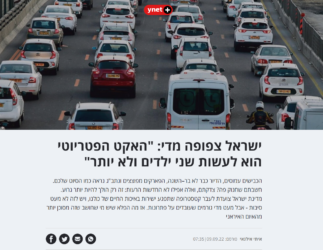
Israel is too crowded
One of the most prominent effects of population growth is the crowding of more and more Israelis in the tower neighborhoods.
However, according to Prof. Rachelle Alterman, the Israeli policy of encouraging residential towers is a “poisonous solution”
The Skills Interface Program in Mathematics, Science and Technology (STEM)
Arnon Bentur, Tamar Dayan, Avigdor Zonnenshain, Eli Eisenberg, Inna Zertser
The insight that has been established in recent years regarding education, in all its components, from preschool to academia, is that it is not enough to impart knowledge and it is necessary in the modern era to also impart skills and competencies, which should be part of the mission of the school system, higher education and lifelong learning in the 21st century.
The Ministry of Education has set a national goal for imparting, developing and evaluating skills and competencies that promote excellence in the entire education system in Israel, for the successful integration of graduates in academia, industry and society.
The Ministry of Education, in collaboration with the Samuel Neaman Institute and the Technion, conducted a pioneering study (pilot) on the development and implementation of an interface between the scientific and technological education in the education system, and the scientific engineering education in the school, for the purpose of acquiring and developing the required skills and competencies.
The skills chosen for purchase are in line with the skills led by the Ministry of Education.
A broad ecosystem has been built which includes all relevant stake holders for acquiring, teaching and evaluating skills: the Ministry of Education, the schools, the IDF, the Technion I.I.T, Beit Berel Academic College and the National Center for Examinations and Assessment and the Szold Institute.

The gas crisis/ Interview with Prof. Ofira Ayalon on ‘Seder Yom’ with Keren Neubach
Prof. Ofira Ayalon in an interview on the energy crisis in Europe considering the Ukraine – Russia war and climate change effects
Link to the full interview with Prof. Ayalon (starts at 35:50)
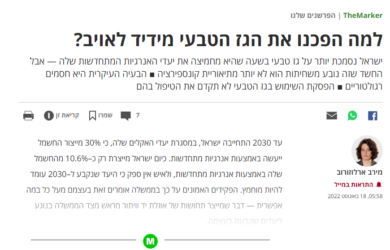
Why did we turn natural gas from a friend to an enemy?
Meirav Arlosoroff examines the question of greenhouse gas emissions from the natural gas supply chain.
Prof. Ofira Ayalon reports on a study examining these issues, in collaboration with the Ministry of Energy, and points to previous reports on the subject under Samuel Neaman Institute
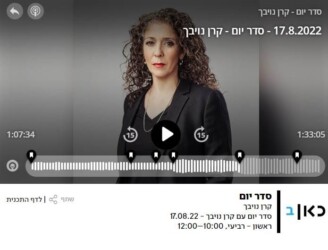
‘Seder Yom’ with Keren Neubach Interview with Prof. Ofira Ayalon
Prof. Ofira Ayalon in an interview on the effects of the extreme climate events of summer of 2022 in Italy and in Europe, in general. Impacts on the economy, health, supply chains, and the energy and water sectors
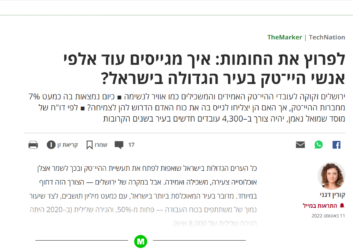
Breaking through the walls: How do you recruit thousands more high-tech professionals in Israel’s largest city?
Tsipy Buchnik, Ella Barzani, Daphne Getz, Ayelet Raveh, Eliezer Shein, Sima Tziperfal, Avida Shoham, Oshrat Katz-Shacham
Jerusalem needs the affluent and educated high-tech workers like air for breathing.
According to a report by Samuel Neaman Institute, there will be a need for 4,300 new employees in the city in the coming years. Will they be able to be recruited?