Wanted: water technologies in oil and gas searching field
Israeli water technologies industry has become one of the world’s most desirable in recent years. Commercial attaches from variety embassies are interested in the products Israeli companies have to offer and it appears that the Ministry of Economy took the hint and established a unique project that will examine the following challenges of the companies in the field. The research project, which is sponsored by the Ministry in cooperation with Samuel Neaman Institute and the Export Institute, will ask to map the global challenges for Israel’s water industry.
The journey to excellence in the Galilee
The motive of the initiators and founders of the program, Dr. David Ben Tolila (Western Galilee College), Giora Shalgi, Dr. Avigdor Zonnenschein and Hava Sher (Rafael), was the need, raised by a number of industry bodies, to invest in improving the competitiveness of northern industry in general and the Galilee in particular.
Anyone who thinks to impose general studies does not know the Ultra-Orthodox community
Dr. Reuven Gal, head of an Ultra-Orthodox Integration Project at the Technion: The way the government operates and mainly the statements of the last few days, instead of promoting the matter- create just the opposite.
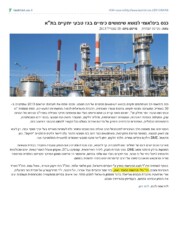
An International Conference on Chemical uses of natural gas will be held in Tel Aviv
An International conference on ‘chemical uses of natural gas’ will open the ISRACHEM 2013 exhibition that will be held on April 30. The conference and exhibition will be held under the auspices of the Ministry of Energy, the Israel Chemical Society and the Manufacturers Association. Under the heading “Natural gas is much more than a cheaper fuel,” will gather under one roof renowned personalities from leading research institutions in the U.S. and representatives of giant companies.
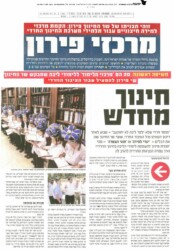
Re-education
According to a research report published by the Samuel Neaman Institute at the Technion a year ago and was also placed on Piron’s desk, there is no feasibility at this stage to make core studies an integral part of the Haredi curriculum. Nevertheless the study suggests a model that will enable a state funded extracurricular study framework that will allow parents who so desire, to send their children to study core subjects in kind of an informal study framework.
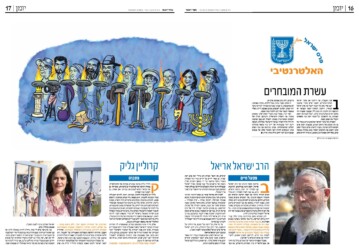
The Alternative Israel Prize – Top Ten
The newspaper “Makor Rishon”, a religious Zionist publication, has selected 10 Israeli candidates for the “Alternative Israeli Award.” One of these is Dr Reuven Gal, chosen for his Social Contribution.
“We chose people. Not slogans. Because we believe that for a better country, we need good people, those you can follow and learn from”.
Regarding Reuven Gal: “In his current position as head of the ‘Ultra-Orthodox Integration Project’, in the Samuel Neaman Institute for National Policy at the Technion, Gal focuses on the possibilities of Ultra-Orthodox integration into the employment market, and in proactive delivery of information on this topic to policy makers. Previously the founder and first director of the National Civic Service in the Prime Minister’s Office, Gal managed to double the number of military exempt Haredim and Arabs participating in the National Civic Service.
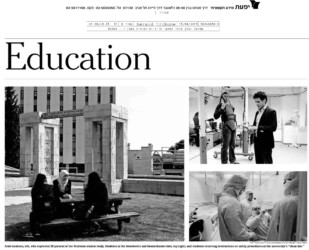
The school behind Israel’s tech evolution
Since it opened in 1923, Technion has been a generator of innovation.
Let’s talk about it on “equal burden”
The Subject of “equal burden” follows the State of Israel since its establishment, and last year, following events such as: Elimination of “Tal Law” by the Supreme Court in early 2012, establishment of the Committee for promoting integration and equality in the burden (“Plesner Committee”) and the raising of the issue on public agenda by parties as “Yesh Atid”, “HaBayit Hayehudi” and “Kadima “- it’s taking up a large part of the public discourse.
On this burning subject, will focus the program “Let’s Talk About It” that will be broadcast on April 10, 2013, from 9:00 p.m. to 23:00, on Reshet Bet of Kol Israel.
Read more about what’s going to be broadcast, and the participants in the panel. The talk show will be led by Michael Miro, CEO of Kol Israel.

The Technion: Israel’s Hard Drive
When the Technion class of 1957 graduated, its members got together and wrote a letter of complaint to their prime minister, David Ben-Gurion, who was otherwise busy building a nation. “There were no jobs for us in our fields,” recalls Gideon F. Inbar, an electrical engineer who is now 79. “My wife kept saying, ‘Oy, things are grim, grim, grim.’ ”
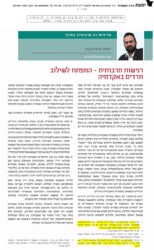
Cultural sensitivity -The key to Ultra-Orthodox integration in the Academy
If the leaders of higher education want to enable quality and academic excellence to the entire society and avoid creating various classes, they must find a way to integrate the Haredi students, which are an integral part of the future generation of the academy, within colleges and universities, while showing cultural sensitivity that matches their worldview and way of life of the Haredi community.