

Gender Index: Only one in six CEOs is a woman
Gender gaps are slowly narrowing, according to Equity Gender Index, published by WIPS – Center for the Advancement of Women in the Public Arena at the Van Leer Jerusalem Institute.
The index is being published for the seventh time with the aim of being a tool for policy design and promotion, and presents a detailed picture of the state of inequalities in various spheres of life – work, education, poverty, political and economic power and more.
The new index will serve as the first comprehensive database of “SHE KNOWS” – A new knowledge center on gender and women in Israel, initiated by the Ministry of Science and Technology, in collaboration with Van Leer Institute, the Samuel Neaman Institute at the Technion and the Public Knowledge Workshop.
Artificial Intelligence and Policy – Update at the beginning of 2020
In parallel with international developments in the field, in recent years research has also begun on the effects of artificial intelligence on different areas of life as well as policy-driven research. It is evident that research in Israel is relatively narrow and retarded in relation to Israeli transportation in the field of artificial intelligence, as is evident, for example, in the amount of companies and startups that deal with the subject. [6] Among the first of the policy studies is a study by the Knesset Research Center written in 2018 at the request of the then chairman of the Science and Technology Committee, MK Uri Maklev. The short document describes the field and seeks to point out areas where policy is needed (Goldschmidt, 2018).
Another study published in the field by the Samuel Neaman Institute for National Policy Studies following an invitation from the National Research and Development Council (MAMOP) examines Israeli activity in the fields of Artificial Intelligence, Data Science and Robotics. Research and extensive activity in the country in these areas (Getz, et al., 2018).
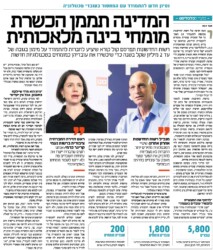
The state will fund the state will fund the training of its artificial intelligence expertsTraining the artificial intelligence experts
Ella Barzani, Daphne Getz, Eran Leck, Sima Tziperfal, Avida Shoham, Roey Tzezana, Shlomo Rosenberg
New attempt to cope with the shortage of technology workers 5,800 employees Shortage of employees in the field of data science according to the Neaman Institute 1,800 Experts Shortage of employees in experts in the data sciences by the Innovation Authority

The ultra-Orthodox will only integrate into society if secular coercion ceases
The key to explaining the fluctuations in ultra-Orthodox society is the realization that for the ultra-Orthodox, the principle of carrot and stick works mainly on the side of the carrot. The operation of a stick – economic decrees, a threat of non-recruitment sanctions, coercive university studies – does the opposite.
The writer, Dr. Reuven Gal, is a senior research fellow at the Samuel Neaman Institute at the Technion, a former chief psychologist in the IDF, Deputy Chief of the NSC and Head of the National Civic Service Administration.
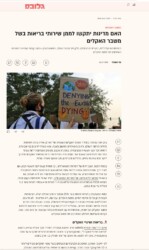
Will countries find it difficult to fund health services due to the climate crisis
On Monday, December 2nd, 2019, the annual UN Climate Summit (COP25) opened in Madrid, to which major delegations from around the world flocked. The Paris Agreement and various layers of the environmental crisis and the need to produce economic and social solutions by states with global cooperation were discussed. Prof. Ayalon, as part of the Israeli Governmental delegation shared her insights from the COP.

“”Maternity leave” for Fathers
Manuel Trajtenberg, Ron Leyzer
The percentage of those fathers who take advantage of maternity leave in Israel is among the lowest in the OECD; only 1% of fathers exercise their privilege. According to Prof. Manuel Trajtenberg’s proposal, rather than extend maternity leave for mothers, men will be required to take at least two weeks of maternity leave, and the total number of weeks on paid leave for both sexes together will total 24 weeks rather than 15 weeks as is the case today.
On the FM 103 radio program of Yinon Magal and Ben Caspit, Ron Leyzer, a Samuel Neaman Institute researcher on gender economics, was interviewed. Leyzer explained the motivation behind this initiative: “Today, women are compelled to take maternity leave”. According to Leyzer, the Israeli model lags behind the rest of the world and works against the best interests of the infant, the parents and the economy.
This research was done at the S. Neaman Institute. The Israeli model in force today lags behind the rest of the world. It is narrow, inflexible and does not place the wellbeing of the infant or the economy at its core. Expanding the various possibilities for the parents means that if the mother desires to remain at home for 15 weeks, she can do that even after the proposed reform. The most important change proposed is to require fathers to take two weeks of leave.
“There are several reasons for this. The idea is for the father’s maternity leave to occur right at the onset of the reform, in order to change the social norm of fathers and employers — fathers may want to take maternity leave but face employers’ opposition.”

Trajtenberg’s recommendations V 2.0 – calling for a new fiscal policy
Manuel Trajtenberg
Prof. Manuel Trajtenberg, Chair of the Committee that brought an end to the social protests eight years ago, is deeply worried. Less about the budget deficit, than about the current process. For the next government, when it is formed, he recommends abandoning the budgetary expenditure principle, in favor of a multi-year program; to raise the tax on value added, and mainly, to make strenuous efforts to restore public trust in government.
“Israel is in the midst of a time in which budgetary policy has been fixed, unchanged, and for years has been dogmatic and obsolete. If the next government fails to change this policy, then we face a serious crisis.” Thus, in sharp words that are in stark contrast to his normally sedate character, Prof. Trajtenberg warns of the coming storm.
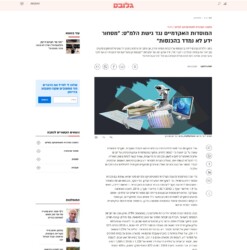
Academic Institutions Against CBS Approach: “Commercialization of Knowledge Not Measured in Revenue”
Arnon Bentur, Moshe Sidi
The “third goal” of the Academy – the transfer of academic knowledge to industry and society.
Although there are successful and well-known cases such as those of Mobilai, whose activities evolved from image processing technology developed by Prof. Amnon Sheshua, one of the company’s founders, in his academic research. Another example is Copaxone, a multiple sclerosis drug developed at the Weizmann Institute, which is responsible for a significant portion of Teva’s revenue. Nevertheless, a report from the Samuel Neaman Institute published in the Globes suggested a policy change that defines the goals of the commercial departments – from financial goals to knowledge dissemination to society and industry.

An interview with Noam Salinger about industrial symbiosis
Noam Salinger of S4 is leading the Northern Industrial Symbiosis program was hosted in a radio show. The Industrial Symbiosis Program is a program in collaboration with the Ministry of Economy, which builds collaborations between factories, businesses, industrial zones, agriculture, and organizations – when waste from one business becomes a profitable raw material for another business. Dr. Gilead Fortuna and Prof. Ofira Ayalon serve as professional consultants for the project.
link :Interviewlink

Biological, biodegradable, or doesn’t it matter at all?
In light of the growing awareness to the problem of plastics in the environment, the subject of alternatives to conventional plastic arise. “The intuition about the behavior of materials in a changing environment is irrelevant. The composition of the materials has to be very well understood, every material behaves differently,” says Prof. Ofira Ayalon, head of environment cluster at the Samuel Neaman Institute and the Department of Natural Resources and Environmental management at the University of Haifa.