


Student Loans for Israel: Learning from International Practice
The proposals of the Shochat Committee on higher education that related to first degree tuition fees and student loans, if implemented, will have far-reaching effects on the higher education system in Israel. Yet, conspicuously lacking in the report is any discussion of the merits of these loans scheme arrangements, in relation to possible alternatives. A […]
An Evaluation of Strategic Arms Limitation Agreements Model, with an Application to the Israeli-Syrian Conflict
This study evaluates the order of magnitude of the monetary cost of achieving an international strategic terror weapons (TWP) limitation agreement in an asymmetric arms race, with an application to the Israeli-Syrian conflict. It extends the Kagan, Tishler and Weiss (2005) framework and develops a model of resource allocation between consumption and security goods in […]
Religious Terrorism: A Cross-Country Analysis
A growing theoretical literature explains why religious organizations are better suited to perpetrate suicide bombings in particular and terror attacks more generally than their non-religious rivals. We offer the first comprehensive test of the roles of religion and religious ideology in terrorism using a unique country level database on domestic terrorism. Our results show that […]
Israel 2028 – Vision and Strategy for Economy and Society in a Global World

This project was initiated and supported by the US Israel Commission of Science and Technology (USISTC). It was managed by a public committee, and carried out over 2 years by some 60 researchers and a significant portion of it was done at the Samuel Neaman Institute. The report was submitted to the Prime Minister who […]
Energy Forum 9: The role of Israel in the global bioethanol market

The ninth meeting of the SNI Energy forum discussed the role of Israel in the global bioethanol market. Issues addressed were related to the Israeli market: technological and economical feasibility, production, use and knowledge development, Including the opportunities of knowledge export from Israel.
Together but Apart: ICT and Productivity Growth in Israel (STE-WP-41)
There is broad consensus regarding the significant role of Information and Communication Technology (ICT) in the past decade, both in the renewal of labor productivity growth in the U.S. and in the development of this productivity gap between the U.S. and the European Union. Israel’s high-tech sector, which is mostly engaged in ICT production, grew […]
Alternatives to recycling and treatment in Haifa
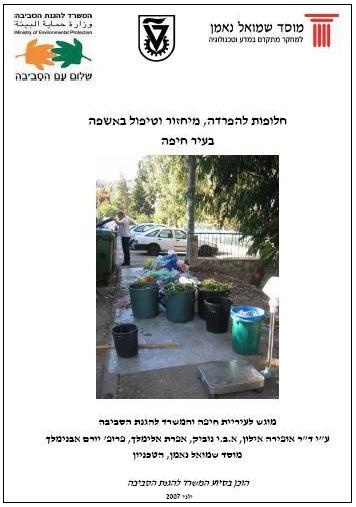
This document examines the feasibility of separation at the source in Haifa and focuses on Greater Neve Sha’anan as a pilot area. It is important to note that this document relates to the separation of waste into two streams only: a clean wet stream, which contains organic waste and is intended for biological treatment, and […]
DISTRIBUTIVE JUSTICE AND REAL PROPERTY: Land Readjustment according to Israeli Planning and Building Law

Real property is notorious for its unequal distributive. Land readjustment is a rare regulatory instrument that can ensure distributive justice. How useful is land readjustment for obtaining land for necessary public services and how does it compare with alternative tools? LR exists in only a few countries, including Israel, usually as a preferred alternative to […]
Proceedings of the International Conference: “Privatization in Higher Education” January 7-8, 2008
Contributions by: Philippe Aghion, Shoshana Arad, Zvi Arad, Elise S. Brezis, Morton M. Denn, Ali Doğramaci, Nehemia Friedland, Sarah Guri-Rosenblit, Grant Harman, Ranan Hartman, Rhanan Har-Zahav, Yaacov Iram, Uri Kirsch, Daniel C. Levy, Nadav Liron, Hagit Messer-Yaron, Gabriel Motzkin, Guy Neave, Thorsten Nybom, Zvi Piran, Sheldon Rothblatt, Eliezer Shalev, Steven Stav and Galit Eizman, Zehev […]
A survey of active researchers at the Russell Berrie Nanotechnology Institute at the Technion
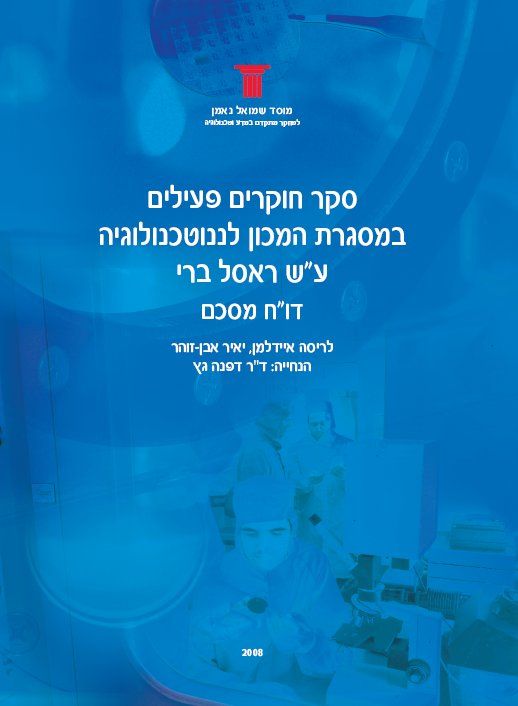
The goal of this survey, prepared by the SNI, was to evaluate the outputs and the outcomes of the Russell Berrie Nanotechnology Institute (RBNI) at the Technion. RBNI was examined over time with the aim of evaluating the results and impact of the research activities within its framework. Several methods were used in the evaluation […]