

Annual Report 2003-2004 Samuel Neaman Institute
The Annual report for 2003-2004 summarizes the Samuel Neaman Institute’s activities for this year in a wide range of subjects
The Society and National Security
What Affects Technion Faculty Members’ Decision to Found a Start-Up Firm? Effects of the Business Opportunity and the Entrepreneur’s (faculty)
While research has recognized the importance of the entrepreneurial opportunity evaluation (EOE) stage in affecting overall entrepreneurship activity, only venture capitalists (VCs) perspectives were explored. No research has attempted to understand the crucial and complementary role of entrepreneurs points of view. In an effort to fill this gap, the current study focuses on the entrepreneur […]
Towards Establishment of Environmental Committees in the Local Councils
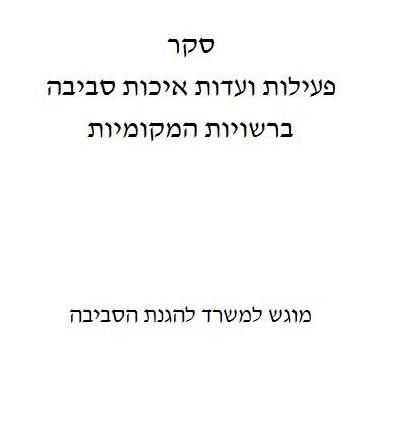
A joint activity between the Samuel Neaman Institute and the Ministry of the Environment, a survey was carried out, as well as other activities, to evaluate the existing situation and prepare for establishment of Environmental Committees in the Local Councils. (Hebrew Version)
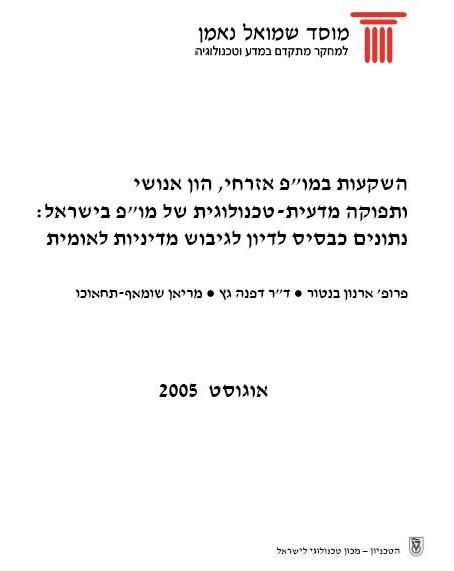
Investments in civilian R&D, human capital, and scientific-technological output of R&D in Israel: Data as a basis for discussion for formulating national policy
Science and Technology Indicators in Israel: An International Comparison
It is well recognized that human capital, especially in the areas of science and technology, (S&T), is the main growth-enabling resource in Israel. How can this recognition be evaluated in light of the economic and statistical data over time? In this new Neaman Institute study we propose a systematic set of indicators, which can and […]
From Ivory Tower to Industrial Promotion:The Case of Yale University and the Biotechnology Cluster in New Haven, Connecticut, STE-WP-28
In 2001 Ernst & Young ranked the state of Connecticut seventh in the nation with respect to the number of biotech firms operating within its borders relative to its population (Ernst & Young, 2001). In 1993 there were only six such companies in the state. What led to this increase? This case study describes the […]
Start-up funding inefficiencies due to VC’s Limited horizon, STE-WP-29

We study the conflict of interests between limited partners (LPs) and a general partner (GP) in a VC fund with a limited life-span. LPs commit money for investment in risky projects, while the GP selects projects and provides unobservable monitoring effort for each project. We assume that midway into the project, the GP privately observes […]
Major Plan for Higher Education – Planning Versus Performance
The higher education system in Israel was based, from the beginning, on academic research in Humboldtian model of teaching and research combined with a strong emphasis on research. Over the years different subjects were added and the requirement to combine in academic studying also professional training increased. Up to a certain stage the Universities succeeded […]
Public vs. Private Technological Incubator Programs: Privatizing the Technological Incubators in Israel STE-WP-26
The Public Technological Incubator Program (PTIP) was initiated in the early nineties by the Office of the Chief Scientist (OCS) in the Ministry of Industry and Trade in Israel in the wake of a large influx of immigrants from the former USSR, many of whom were scientists and engineers. Since the year 2000, private technological […]